Loading
Showing posts with label Indian Veg. Show all posts

Mushroom Kadai

A Mushroom (or toadstool) is the fleshy, spore-bearing fruiting body of a fungus, typically produced above ground on soil or on its food source. The standard for the name "Mushroom" is the cultivated white button Mushroom, Agaricus bisporus; hence the word "Mushroom" is most often applied to those fungi (Basidiomycota, Agaricomycetes) that have a stem (stipe), a cap (pileus), and gills (lamellae, sing. lamella) or pores on the underside of the cap.

Mushroom Kadai is flavor of sub continental style this dish is served mostly in India, Pakistan and Bangladesh.

Mushroom Kadai
Ingredients

  • 200 gm Mushroom
  • 1 capsicum (shimla mirch) 
  • 2 onion (pyaj) 
  • 4 tomato (tamatar) 
  • 1 piece ginger (adrak) 
  • 5-6 garlic (lahsun) buds
  • 2 green chilly (hari mirch) 
  • 1 tsp salt
  • 1/2 tsp red chilly powder (lal mirch) 
  • 1 tsp coriander powder (dhania) 
  • 1/4 tsp turmeric powder (haldi) 
  • 1/2 tsp spice blend (garam masala) 
  • 4 tbsp clarified butter (ghee) 

Method

  • Cut Mushrooms into slices.
  • Cut capsicum into cubes.
  • Finely chop onions and tomatoes.
  • Grind ginger, garlic and green chilies.
  • Heat ghee in a pan and fry onions in it until it turns pink.
  • Then fry ginger paste for a minute.
  • Now put tomatoes and fry until ghee separates.
  • Put salt, red chilly powder, coriander and turmeric powder.
  • Now add Mushrooms and simmer after adding 1/4 cup water.
  • Cook until Mushrooms softens.
  • Then cook capsicum in it for 2-3 minutes and remove it from the flame.
  • Now sprinkle some spice blend.
  • Serve hot.

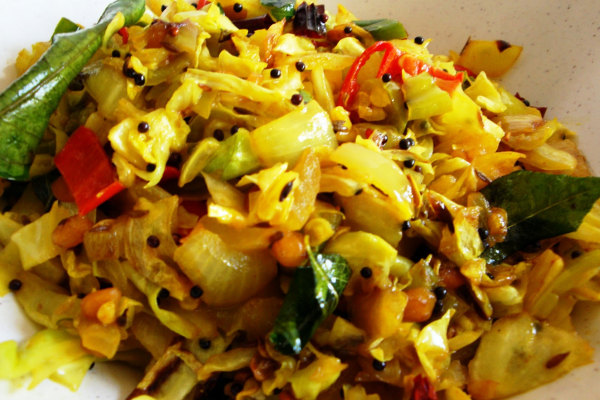
Cabbage Poriyal

Poriyal is the Tamil word for fried or sometimes sauteed vegetable dish. The Kannada word for the same dish is Palya and in Telugu, its Porutu. It is usually made by shallow frying shredded or diced vegetables along with spices. The preparation would normally involve frying mustard seeds, urad dal, onions and then the main vegetable, and finally adding turmeric, spices, dried red chillis and coriander. In Tamil Nadu, shredded coconut would be added as a dressing.
Poriyal serves as a side dish to a three course meal of rice with sambhar, rasam and curd.

Cabbage Poriyal

Ingredients
  • 2 cups shredded cabbage
  • 1 tsp mustard seeds ( rai / sarson)
  • 1/2 tsp urad dal (split black lentils)
  • 1 green chilli, slit
  • 2 whole dry kashmiri red chillies, broken
  • 8 to 10 curry leaves (kadi patta)
  • a pinch of turmeric powder (haldi)
  • 1/4 cup grated coconut
  • 2 tsp oil
  • salt to taste
Method
  • Heat the oil, add the mustard seeds and urad dal and let the seeds crackle.
  • Add the green chilli, dry red chillies, curry leaves and turmeric powder and stir for few seconds.
  • Add the cabbage, salt, 1/4 cup of water and cook over a medium flame till the cabbage is tender.
  • Add the grated coconut, mix well and serve hot.


Paneer Bhurji

Bhurji means scrambled. So as the name suggests, this cheesy delicacy is made out of scrambled cottage cheese. This dish is quick to prepare and yet it so full of flavor  A protein rich dish whose beauty lies in it’s simplicity. A hearty and satisfying dish that goes great with rice or breads


Paneer Bhurji
Ingredients
  • 1 cup crumbled paneer
  • 1 finely chopped tomato
  • 1 finely chopped onion
  • 1 chopped green chilly
  • 1 finely chopped ginger
  • 1/4 tsp turmeric powder
  • 1/4 tsp chilly powder (optional)
  • 1/4 tsp garam masala powder (optional)
  • 1/4 tsp cumin seeds (optional)
  • salt for taste
  • oil 3 tsp
Method

  • Have one cup crumbed Paneer ready or try to smash or crumbed Paneer from your Refrigerator
  • Heat oil in a pan. Add cumin seeds first. Once they get fried, add onions. When the onions become transparent, add chopped ginger and chilly.
  • Fry the ginger for a while. Then add tomatoes and cook till they become soft. You can add a little salt  and Turmeric so that the tomatoes get cooked faster.
  • Now add all the Masala powders if required red chilly powder too.  Fry for a minute add then add crumbled Paneer and let it cook for 1-2 minutes. Don’t cook the Paneer for a long time as they harden and loose their softness.
  • Serve Paneer Bhurji with Rotis and rice.

Egg Kadai


Simple Indian Boiled Egg Kadai  or Anda Kadai is an Indian non veg dish. This delicious and healthy food is very simple to prepare . You can serve Simple Indian Kadai Boiled Egg Roast with the plain white rice , bread,sandwiches and fried rice.

Egg Kadai
Ingredients
  • Eggs-8 no’s
  • Green chilly chopped-6 no’s( adjustable according to your taste)
  • Onion sliced-2 small size
  • Ginger paste- 2tbsp
  • Garlic paste-2 tbsp
  • Oil for making thick gravy- 3tbsp
  • Oil for frying the eggs- 1/2 cup
  • Bay leaves(Karuga/Vazhana ela) – 3nos
  • Cinnamon(Karugapatta) - 1" piece
  • Cardamom(Elakka) - 5 nos
  • Cloves(Grambu) - 4 nos
  • Fennel(Perum Jeerakam) - 2 tsp
  • Curry leaves – 2 stems
  • Chilly powder – 1 1/2 tbsp ( adjustable according to your taste)
  • Coriander powder – 1 tsp
  • Turmeric powder – 1/4 tsp
  • Salt- as required
Method
  • Boil the eggs in water.
  • Give small cuts on each egg with a knife. Otherwise they will blast like bombs when you fry in the oil.
  • Heat a frying pan and pour ½ cup of oil into it.
  • Let the oil be boiled.
  • Fry all the eggs with the minimum heat in the oil till they turn to light brown .
  • Keep the fried eggs aside.
  • Prepare Gharam Masala by grinding together bay leaves, cinnamon, cardamom, cloves, black pepper seeds and fennel.
  • Heat one vessel and add 3tbsp of oil.
  • Add all sliced onions and saute till brown.
  • Add ginger and garlic paste and saute till brown.
  • Add the green chilies and curry leaves.After 1 minute you’ll get an amazing flavor.
  • Add all the powders.
  • Stir in gentle heat until light brown.
  • Add ¼ cup of water and mix well for 1 minute.
  • Add the fried eggs and cover them with the thick masaala.
  • Cover with a lid and cook for 2 minutes in gentle heat.
  • Turn off the heat and decorate with the curry leaves or coriander leaves.
  • Serve Simple Indian Kadai Boiled Egg Roast hot with bread,sandwiches and fried rice.

Punjabi Aloo Gobi Masala

Aloo Gobi Masala is a flavorful Indian vegetarian dish made with potatoes, cauliflower and many spices which makes it fragrant and mouth-watering.  Lets see the preparation details.

Punjabi Aloo Gobi Masala
Ingredients

  • 2 large Potatoes (about 2 cups), scrubbed, peeled and cut into 1/2 inch cubes
  • 1 medium Cauliflower (about 3-4 cups), cut into medium sized florets
  • 1 large Onion, finely chopped
  • 1 tsp Ginger-Garlic Paste
  • 2-3 Green Chillies, roughly chopped (Adjust acc to taste)
  • 2-3 tbsp Coriander Leaves, finely chopped
  • 1 1/2-2 tbsp Oil
  • 1 tsp Jeera/Cumin Seeds
  • A pinch of Hing/Asafoetida (Optional)
  • 1/2 tsp Haldi/Turmeric Powder
  • 3/4 tsp Red Chilli Powder (Adjust acc to taste)
  • 1/2 tbsp Dhania/Coriander Powder
  • 1/2 tsp Garam Masala (Adjust acc to taste)
  • 1/2 tsp Kitchen King Masala (Optional)
  • 1/2 tbsp Kasuri Methi/Dried Fenugreek Leaves (Optional but recommended)
  • Freshly squeezed Lime/Lemon Juice to taste
  • Salt to taste

Method
  • Heat oil in a pan and add cumin seeds and hing. When cumin seeds crackle and change colour, about 30 seconds, add finely chopped onions.
  • Sauté the onions till they turn translucent and then add ginger-garlic paste, green chillies and crushed kasuri methi leaves. Give it a good stir till the raw smell of ginger-garlic paste disappears, about 1 minute.
  • Next add all the spice powders and give it a good stir for 30 seconds.
  • Mix in cubed potatoes and give them a good stir for 3-4 minutes.
  • Add cauliflower florets and salt to taste and stir them for 2-3 minutes, making sure every individual cauliflower florets are coated with spice mix.
  • Cover the lid and let it cook for 7-10 minutes, stirring in between to make sure that vegetables don’t stick the bottom of the pan. By now the vegetables gets cooked through but still retain their shape. If not, cover and let them cook for another 3-5 minutes.
  • Switch off the gas and add freshly squeezed lemon/lime juice to taste. Garnish with finely chopped coriander leaves and mix them well before serving this delicious Aloo Gobi with Roti or plain/flavoured rice.


Cabbage Fry

Cabbage is a popular cultivar of the species Brassica oleracea (Capitata Group) of the family Brassicaceae (or Cruciferae) and is a leafy green vegetable. It is a herbaceous, biennial, dicotyledonous flowering plant distinguished by a short stem upon which is crowded a mass of leaves, usually green but in some varieties red or purplish, which while immature form a characteristic compact, globular cluster (cabbagehead).
History

The cultivated cabbage is derived from a leafy plant called the wild mustard plant, native to the Mediterranean region, where it is common along the seacoast. Also called sea cabbage and wild cabbage it was known to the ancient Greeks and Romans; Cato the Elder praised this vegetable for its medicinal properties, declaring that "It is the cabbage that surpasses all other vegetables." Cabbage was developed by ongoing selective breeding for suppression of the internode length. The English name derives from the Normanno-Picard caboche (head), perhaps from boche (swelling, bump). Or perhaps from the Latin for "head": Capus; in standard modern Italian: Capo. There is an Italian dialect word for head: Capoccia.
Use

The only part of the plant that is normally eaten is the leafy head; more precisely, the spherical cluster of immature leaves, excluding the partially unfolded outer leaves. Cabbage is used in a variety of dishes for its naturally spicy flavor. The so-called "cabbage head" is widely consumed raw, cooked, or preserved in a great variety of dishes.

Cabbage Fry
Ingredients
  • Cabbage - 1/2 head, finely sliced
  • Mustard seeds - 1/2 tsp
  • Cumin seeds - 1/2 tsp
  • Split gram dal - 1 tsp
  • Dry red chilies - 1, tear and de-seed
  • Curry leaves - 1 sprig
  • Asafoetida - 1/4 tsp
  • Ginger - 1/2 tsp, finely minced
  • Turmeric powder - 1/2 tsp
  • Green chilies - 2, slit half way through
  • Coriander powder - 1/2 tsp (optional)
  • Fresh grated coconut - 2 tbsps (optional)
  • Cooking oil - 1 tbsp
  • Salt to taste

Method
  • Heat oil in a heavy bottomed vessel.
  • Add mustard seeds and allow to splutter.
  • Add cumin seeds and urad dal and allow to turn light brown.
  • Add dry red chilies, green chilies, ginger, curry leaves, asafoetida and turmeric powder and saute for a few seconds on medium flame.
  • Add the sliced cabbage and mix to combine well. Cook without lid for 9-10 mts.
  • Lower flame, place lid and cook for 15 mts stirring once in a while.
  • Remove lid, add coriander powder and salt and mix.
  • Cook for another 5-6 mts and turn off heat.
  • Garnish with chopped coriander leaves or grated coconut.
  • Serve warm with rice or rotis.

Pachi Pulusu

Pachi Pulusu is an unheated version of the pulusu, a type of curry-like stew from Andhra Pradesh. Unlike regular pulusu, this kind is much more watery and light. Typically this dish is prepared with tamarind with onions, chillies, and jaggery. Other typical Andhra Pradesh seasonings may be added, such as coriander, curry tree leaf, or garlic. In the summer when mangoes are abundant, tamarind is replaced by stewed raw mango.
Pachi Pulusu
Ingredients
  • Tamarind, the size of a small lemon
  • One-half of a small onion finely chopped
  • 1 finely chopped green chili
  • 1-2 tbsp finely chopped coriander
  • Red chili powder 1/4 tsp
  • Jeera powder 1/4 tsp
  • Coriander powder 1/4 tsp
  • A pinch of garam masala powder
  • Salt to taste
  • Water 4 cups

Method
  • Wash and soak tamarind in water for about an hour.
  • Extract the juice from soaked tamarind and discard the tamarind pulp.
  • Add finely chopped onion, green chilies, and coriander leaves. Add red chili powder, jeera powder, coriander powder, garam masala, and salt to taste.
  • Stir and let it stand for about one-half hour before serving.

Kadhi Pakora

Kadhi or Karhi  is an North Indian and Pakistani dish. It is a spicy dish whose thick gravy is based on chickpea flour (called Besan in Hindi) and contains vegetable fritters called pakoras, to which sour yogurt is added to give it little sour taste. It is often eaten with boiled rice or roti. Among the Sindhi people, its other is variety popular and often vegetables are also added.

India

In North India, pakodas are added to the chickpea gravy and sour yogurt is added to add flavour to it. They are eaten either with boiled rice or roti. In Rajasthan and Gujarat, it is usually served with khic?i, roti, parantha and rice. It is considered a light food. Rajasthani and Gujarati kadhi differs from the northern varieties. Traditionally, it is sweeter than the other variants, because sugar or jaggery is added to it, but it can be made without sugar for a more sour taste. It is eaten without pakoras and its consistency is slightly thinner than the kadhi made in the North. The Gujarati kadhi is made preferably from buttermilk as it gives a more smooth texture compared to yogurt. Variations on this basic dish includes the addition of certain vegetables, notably bhindi (okra) in which case it is known as bhinda ni kadhi.
The Sindhi diaspora in India usually make kadhi by first roasting the chickpea flour and adding vegetables to the chickpea gravy. Instead of yogurt, tamarind pulp is used to give it a sour taste.


Pakistan

In Pakistan, it is usually served with boiled rice and naan. Fish Karhi and Egg Karhi are also popular in Pakistan.


Kadhi Pakora
Ingredients
  • 2 cups sour curd
  • 1 cup water
  • 2 tsp gram flour (besan)
  • 1 tsp oil
  • 1 tbsp ginger & green chilli paste
  • 1 tsp cumin seeds (jeera)
  • 1 tsp mustard seeds
  • a pinch of asafoetida (heeng)
  • 6 - 7 curry leaves
  • Salt & black pepper powder (to taste)
  • 2 dry red chillies
  • 1/2 turmeric powder (haldi)
  • 1/2 tsp red chilli powder
  • 1/2 tsp garam masala powder
  • 1 tbsp chopped coriander (to garnish)

For Pakoras

  • 1/2 cup gram flour (besan)
  • 1 small onion (chopped finely)
  • 1/4 tsp fruit salt or a pinch of soda-bi-carbonat
  • 1 tsp dried fenugreek leaves (kasoori methi)
  • Salt, black pepper and red chilli powder (to taste)
Method
  • Mix all ingredients of Pakoras and add water to make a thick batter of dropping consistency.
  • Shaped Pakoras stuff heat it in Oil until it get borwn in color.
  • Add mustard seeds, cumin seeds, asafoetida, curry leaves, red chilli, turmeric powder and salt.
  • Add chilli-ginger paste heat it for 5 mins.
  • Beat curd, water and gram flour to make a smooth mixture.
  • Add this mixture to masala, heat for 10 – 15 mins . Stir in between.
  • Add the Pakoras to the kadi and heat it for 10 mins.
  • Garnish with chopped coriander leaves. Serve with boiled rice / roti.


Rajma Chawal / Razma Chawal

Rajma or Razma is a popular North Indian vegetarian dish consisting of red kidney beans in a thick gravy with lots of Indian whole spices and usually served with rice and roti. Although the kidney bean is not of Indian origin, it is a part of regular diet in northern regions Punjab, Kashmir, Delhi, Haryana and Himachal Pradesh. This dish developed after the red kidney bean was brought to the Indian subcontinent from Central Mexico and Guatemala.
Rajma Chawal
Ingredients
  • 1 cup Rajma/Red Kidney Beans
  • 1/2 cup finely chopped onions
  • 1 teaspoon chopped ginger
  • 1 cup chopped tomatoes
  • 1 teaspoon cumin seeds
  • 1 teaspoon turmeric powder
  • 1 teaspoon cumin powder
  • 1 teaspoon garam masala powder
  • 1 tablespoon butter
  • 2 tablespoons chopped coriander leaves
  • 1 teaspoon Vegetable/Sunflower Oil
  • Salt to taste
Method
  • Cook the soakedrajma (soaked overnight/8 hours) in about 3 cups of water in a pot or a pressure cooker until the rajma is soft, tender and cooked. Takes about 30 to 40 minutes, depending on the age of the beans.
  • Heat oil to a sauce pan, add chopped ginger and onions. Sauté until onions are soft and golden brown.
  • Add chopped tomatoes, turmeric powder, cumin powder, garam masala powder and sauté until tomatoes become soft.
  • Add the cooked rajma , salt, 1 cup water and butter and simmer for 30 minutes. The longer you simmer the more the spices get into the rajma and the tastier it gets. You can alter the consistency of the gravy by adding more water.
  • Garnish with coriander leaves and serve hot with warm long grained rice.

Stuffed Eggplant Curry / Gutti Vankaya Kura

Stuffed Eggplant Curry or Gutti Vankaya Kura is more popular in common dish in Andhra, this dish is used in Rayalaseema areas like kurnool, Kadpa etc.

Gutti Vankaya Kura

Ingredients

  • 1/4 kg purple brinjals, wash, make quarters (pieces) with their stalk intact take small lemon sized tamarind, extract their pulp
  • 1 1/4 tbsps of oil
For stuffing
  • 1 large onion, sliced
  • 1 cinnamon stick
  • 1 tsp red-chilli powder
  • 1 tsp coriander powder
  • 4-5 garlic cloves
  • 1 1/2 tsps ghee or soft butter
  • 1/2 - 1 tbsp grated jaggery or sugar (which ever is available)
  • Add salt to suit your taste
For tadka (seasoning)
  • 1/4 tsp methi seeds
  • A stack of curry leaves

Method
  • Add 1 tsp oil in a cooking vessel, add garlic and cinnamon stick and saute for a few seconds.
  • Add the sliced onions and saute till the rawness disappears and it becomes golden brown. Approx 4-5 mts. Keep aside to cool.
  • Once cool, make a coarse paste of it. Remove the paste into a bowl, then add salt to taste, red chilli powder, jaggery (or sugar), coriander powder and ghee. Combine well and stuff the brinjals with this paste.
  • Add the remaining oil in a vessel, add curry leaves and toss them for a few seconds. Add the methi seeds and let them turn brown.
  • Place the stuffed brinjals in the oil and cook on medium high flame for 2 mins. Now, cover with lid and let them cook on medium low flame for about 12-14 mins. Keep checking in between and stir fry to ensure they don't burn or stick to the pan.
  • Add the tamarind extract along with a cup of clean water. Bring to a boil and reduce flame and place lid and cook over low flame for about 13-15 mins. The water content should evaporate while cooking.
  • Remove lid and cook over low flame and let the brinjals roast well and it appears like a dry saute. It should take about 8-10 mins for the brinjals to be well roasted. Turn off the heat.
  • Serve with hot plain steamed rice.


Shahi Paneer

Shahi Paneer is a preparation of paneer, cream, tomatoes and spices. Thick, creamy and spicy, it is a mainstay of Indian cuisine.
Shahi Paneer is immensely popular, especially in North India. It is typically eaten with Roti, Chappati or other Indian breads. Paneer is the Indian word for cottage cheese, and Shahi is the Indo-Persian term for royal (in reference to the Mughal court).

Shahi Paneer
Ingredients
  • Paneer (Indian cottage cheese) - 250 gms
  • Ghee - 4 tbsp.
  • Onion – 1 (chopped into strips)
  • Ginger - 1/2 inch piece (chopped finely)
  • Green chillies – 2 (chopped finely)
  • Curd -  1/4 cup
  • Red chilli powder - 1/2 tsp.
  • Garam masala - 1/2 tsp.
  • Milk - 1/2 cup
  • Tomato sauce - 2 tbsp.
  • Tomatoes – 4 (chopped finely)
  • Cardamom – 2 (crushed)
  • Cashew nuts – 10 (made into a paste)
  • Salt to taste
Method
  • Cut the Paneer into medium sized cubes. Take a pan on medium heat. Add 1 tbsp ghee and fry the paneer cubes for around 3 minutes and keep it aside.
  • Heat 2 tbsp. ghee in  a pan. Add onion,ginger, green chilli and cardamom. Fry for 3-4 minutes.
  • Add tomatoes and cook for 7-8 minutes with the lid covered on the pan.
  • Add curd and cook for 5 more minutes.
  • Add 1/2 cup water and allow the contents to cool.
  • Blend in a blender till smooth.
  • Heat remaining ghee and add gravy.
  • To this add tomato sauce, chilli powder and garam masala.
  • Boil to get a very thick gravy.
  • Now add milk, cashew nut paste and paneer. Mix well and boil for 3-4 minutes.
  • Garnish with chopped coriander and serve.

Sakarai Pongal / Sweet Pongal

Pongal (Tamil: பொங்கல்,Telugu: పొంగలి) is a popular rice dish based in South India. Pongal is unique to Tamil cuisine, but related toKhichdi.
There are two varieties of pongal, namely, sakarai pongal (sweet pongal) and ven pongal (spicy pongal). The unqualified word pongalusually refers to spicy pongal, and is a common breakfast food in several parts of India. The rice boiled with milk and jaggery during thePongal festival is also called pongal - this is sweet pongal made specially in earthenware pots with a wood fire.

Sakarai Pongal

Sakarai pongal (sweet) is generally prepared in temples as a prasad, i.e., offering to God. This type of pongal is also prepared during the Pongal festival (similar to Thai Pongal) in Tamil Nadu,South India.
Sakarai means sugar in the Tamil language. It tastes sweet and contains ingredients like rice, sugar/jaggery, coconut pieces or moong daal. The sweetening agent in sakarai is traditionally jaggery, but sometimes candy sugar can be added. This makes a white looking pongal, but adding jaggery makes a darker brown coloured pongal.


Ingredients
  • 1 cup Raw Rice
  • 1/2 cup Green Gram Dal
  • 1 cup Milk
  • 3 cups Jaggery (powdered)
  • 4 tbsp Ghee
  • 2 tbsp Cashewnuts
  • 2 tbsp Raisins
  • 5 no Cardamoms (powdered)
  • 2 no Cloves (powdered)
  • 1 small piece Nutmeg (grated or powdered)
  • A pinch of Saffron
  • 2 1/2 cups Water
Method
  • Roast dry the green gram dal for a couple of minutes.
  • Cook the rice and green gram dhal with 2 1/2 cups of water and 1 cup milk in the microwave and set aside.
  • Dissolve the jaggery in 3/4 cup water and cook on a low heat till the jaggery melts.
  • Strain the jaggery to remove the dirt.
  • Put the syrup once more on the heat and stir till it becomes slightly sticky.
  • Add the cooked rice and dhal.
  • Heat the 4 tbsp ghee.
  • Fry the cashewnuts and raisins and add to the pongal.
  • Add the powdered cardamoms, cloves nutmeg and saffron.
  • Mix well and serve hot.

Natu Kodi Pulusu / Country Chicken Stew


Natu Kodi Pulusu / Country Chicken Stew is one of famous dish from Andhra region.  It is widely used in coastal and southern part of the Andhra region.  this dish is widely used for morning breakfast either with Dosa or Idly. 
Natu Kodi Pulusu
Ingredients
  • 1/2 KG Country Chicken cut them into big pieces
  • 1 table spoon Lemon Juice
  • 5 Green chilis
  • 3 Tomato
  • 1 1/2 tea spoon Ginger Garlic paste
  • 2 tea spoon Red chili powder
  • 1/2 tea spoon Turmeric Powder
  • 1 tea spoon Coriander powder
  • Tamarind (small lemon size)
  • 3 cloves
  • 1/2 inch Cinnamon stick
  • 2 seeds Cardamom
  • 1 tea spoon Poppy seeds
  • 2 Onion
  • Salt ( as required)
  • 2 table spoon Oil (for taste use Groundnut oil)
  • 1 1/2 cups of water.
Method
  • Clean and wash chicken pieces and add lemon juice, Ginger Garlic past, Turmeric and some salt and keep the pieces side.
  • Include Cloves, Cinnamon, Cardamom, Poppy seeds, Tamarind, 1 Onion and grind all of them and into a smooth paste to make them paste include few water or oil.
  • Take a Pan and heat them with oil
  • Add few chopped onion once they trun into gold colour add some Ginger Garlic paste, turmeric powder, chopped tomato, red chili powder and coriander powder and stir for few seconds.
  • After some time add grounded paste and fry till nice aroma come out and oil leaves the pan sides.
  • Now add chicken pieces and fry for 2-3 mints in oil.
  • Now add those fried chicken pieces into juices and stir in between approximately for 5-10 mints in low flame.
  • Now open the lid ad add 1 1/2 cup water mix well and bring to full boil now cover and cook for 10 mint or till chicken become tender.

Andhra Chapala Pulusu / Andhra Fish Stew


Andhra Chapala Pulusu or Andhra Fish Stew is one of famous coastal food.  Andhra is more famous for its own spice and this stew made of the tangy tamarind and coriander stew.  This dish is served with rice and mostly seen in coastal areas of Andhra.  Nellore region is more known for this dish.


Andhra Chapala Pulusu


Ingredients

  • Cat fish – 2 lbs
  • Tomato – 1 medium size
  • Onions – 2 medium size
  • Green chilies – 6
  • Ginger, garlic paste – 1 table spoon
  • Methi seeds – 1 tsp
  • Cumin seeds – 1 tsp
  • Turmeric powder – 2 tsp
  • Olive oil – 2 Table spoons
  • Poppy seeds – 1 table spoon
  • Dry coconut powder – 1 table spoon
  • Tamarind – big lemon size ball (add water and microwave it for 1 min prior to starting the dish)
  • Salt for taste
  • Red chili powder – 1 table spoon
  • Coriander leaves for garnish
  • Garam masala powder - 1 tsp

Method
  • Clean the fish with salt and turmeric and cut into big cubes
  • In a wide non stick pan take ½ table spoon of oil and fry the pieces on both sides until golden brown. Leave it aside without taking out from the pan.
  • In another pan take the remaining oil and add finely chopped onions and chilies fry till golden brown.
  • Add ginger garlic paste, above onion paste, turmeric powder, salt and red chili powder. Mix the contents thoroughly and fry it in simmer until the raw smell of ginger garlic disappears. Add the poppy seeds mix. Now add 1 chopped tomato, let it cook on low heat until the contents become to paste consistency.
  • No need to add water yet since the tomato is added. To this mixture add tamarind juice, add water to the gravy until the right sour taste and consistency is reached, and make sure the salt and chili powder is enough. Let it come to a boil, then simmer for 10 min. becomes semi thick tasty gravy (pulusu).
  • Now, transfer all the gravy into the big pan where the fish was fried before. Hold the pan and move it side by side, do not use a spatula to mix since the fish pieces will fall apart. Let it simmer on low flame until the oil separates from the gravy.
  • Garnish with garam masala and coriander leaves.
  • Serve with hot rice. Tastes great once the dish cools down.

Chicken tikka masala


Chicken tikka masala is a curry dish of roasted chicken chunks (tikka) in a spicy (masala) sauce. The sauce is usually creamy, spiced and orange-coloured. Chicken Tikka masala has been found to be the most popular dish in British restaurants and it has been called "a true British national dish. 

One in seven curries sold in the UK is chicken tikka masala. The cross-cultural popularity of the dish in the UK led former Foreign Secretary Robin Cook to proclaim it as "a true British national dish" It is also widely served in India, especially in major cities such as Mumbai, New Delhi and Chandigarh. Some restaurants in Pakistan and Bangladesh offer chicken tikka masala, especially if they expect tourists from the United Kingdom as clients.


Chinken Tikka Masala


Ingredients
  • 1 cup yogurt
  • 1 tablespoon lemon juice
  • 2 teaspoons ground cumin
  • 1 teaspoon ground cinnamon
  • 2 teaspoons cayenne pepper
  • 2 teaspoons freshly ground black pepper
  • 1 tablespoon minced fresh ginger
  • 4 teaspoons salt, or to taste
  • 3 boneless skinless chicken breasts, cut into bite-size pieces
  • 4 long skewers
  • 1 tablespoon butter
  • 1 clove garlic, minced
  • 1 jalapeno pepper, finely chopped
  • 2 teaspoons ground cumin
  • 2 teaspoons paprika
  • 3 teaspoons salt, or to taste
  • 1 (8 ounce) can tomato sauce
  • 1 cup heavy cream
  • 1/4 cup chopped fresh cilantro


Method
  • In a large bowl, combine yogurt, lemon juice, 2 teaspoons cumin, cinnamon, cayenne, black pepper, ginger, and 4 teaspoons salt. Stir in chicken, cover, and refrigerate for 1 hour.
  • Preheat a grill for high heat.
  • Lightly oil the grill grate. Thread chicken onto skewers, and discard marinade. Grill until juices run clear, about 5 minutes on each side.
  • Melt butter in a large heavy skillet over medium heat. Saute garlic and jalapeno for 1 minute. Season with 2 teaspoons cumin, paprika, and 3 teaspoons salt. Stir in tomato sauce and cream. Simmer on low heat until sauce thickens, about 20 minutes. Add grilled chicken, and simmer for 10 minutes. Transfer to a serving platter, and garnish with fresh cilantro.

Sarson ka Saag


Sarson Da Saag (Sarson ka saag, in Hindi, Urdu) is a popular curry in the Punjab region of India and Pakistan made from mustard leaves (sarson) and spices.
It is regarded as the traditional way of making saag and is traditionally served with makki di roti, which literally means (unraised) corn bread. It can be topped with either butter (unprocessed white or processed yellow butter) or more traditionally with ghee (clarified butter). Some spinach (called palak in Punjabi) can be added for added colour and thickening the dish even if this could alter the taste.

Sarson ka Saag

Ingredients
  • 500gms Mustard leaves
  • 200gms Spinach
  • 200gms Bathuwa
  • 3 Garlic cloves
  • 1 inch Ginger
  • 2 Green chilli
  • Salt To Taste
  • 1 tbsp Maize flour
  • 1 Pinch Sugar
  • 2 tbsp Ghee
  • 1 Asafoetida
  • 1 Pinch Onions,
  • 1 tsp chopped Red chilli powder
  • 1 Pinch Turmeric powder
Method
  • Clean and wash sarson, spinach and bathuwa. Chop the leaves finely.
  • Chop ginger, garlic cloves and chillies.
  • Pressure cook the spinach, sarson, bathuwa with garlic, ginger and chillies. When cool, grind it to smooth paste.
  • Heat ghee in a vessel, add hing and onions. Fry until light brown. Add salt and turmeric powder. Mix well.
  • Add the ground saag and simmer the flame. Cook for few minutes.
  • Add the maize flour, red chilli powder, sugar and stir well.
  • Serve hot with paratha or makki ki roti.

Baingan Bartha or Baingan ka Bhurta

History


Baingan Bartha or Baingan ka Bhurta  is a vegetarian dish from Indian and Pakistani cuisine. It is a Bhurta (minced vegetables) made from eggplant (Baigan), which is grilled over charcoal or direct fire to impart a smoky flavour to the flesh of the eggplant and then cooked with spices and vegetables.


It is popular in Punjab, Maharashtra, Bihar, Orissa, and West Bengal. The dish has many names, depending on the local language (Hindi: baingan ka bharta, Gujarati: Odo, Bengali:  begun bhôrta, Marathi: wangyacha bharit). In the South Indian state of Tamil Nadu, the Tamils prepare a similar dish called kathrikai thayir kothsu, in which the eggplant is cooked and mashed and sautéed with mustard, red chilis, and sesame oil, after which curd is added to the mixture and dressed with coriander leaves.


Baingan ka Bhartha

Ingredients

  •  2 Brinjal (Baingan)
  •  1 Large onion (chopped)
  •  1 Large tomato (chopped)
  •  5 Garlic (chopped)
  •  3 to 4 Green Chillies (chopped)
  •  1/2 cup Oil
  •  Fresh Coriander Leaves
Method
  • Roast the brinjal till it turns soft.
  • Peel off the skin and mash it properly.
  • In a pan, heat oil and add green chillies, onions, tomatoes and chopped garlic in it.
  • After about 3 to 4 minutes, as the mixture turns golden brown, add mashed brinjal and salt. Mix it well.
  • Pour a tsp of lime juice over this mixture and garnish it with coriander leaves.
  • Serve Baingan Ka Bartha with rice.


Twitter Delicious Facebook Digg Stumbleupon Favorites More